Eastern Europe
Interview with the VampireEastern Europe is the geographical and imaginative center of Louis and Claudia’s search for an explanation of their existence. Guided by Claudia’s belief that the region preserves the oldest and most prevalent vampire traditions, they travel toward the Black Sea and the Carpathians expecting to find beings who can explain their origins, their powers, and the possibility of true immortality. Instead, the landscape gives them a cruel distinction: the vampires they encounter are animated corpses without memory, language, or inward life, while Louis and Claudia remain conscious, articulate, and burdened by thought.
Definition and Setting
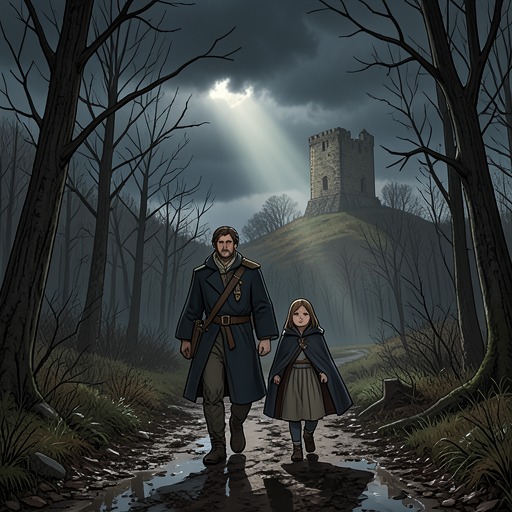
Eastern Europe appears first as a promised source of ancestral knowledge. Claudia studies accounts from the region written by priests, scholars, and travelers, treating them almost as a Bible. These records describe practices that differ sharply from the pair’s own experience of vampirism: suspected vampires are burned, their hearts staked, and their heads severed. Claudia therefore plans a route away from the glittering capitals of Europe toward the Black Sea, with the journey beginning at Varna and continuing through the rural countryside of the Carpathians.
The region is not presented as a single city or community but as a chain of villages, forests, and graveyards across Transylvania, Hungary, and Bulgaria. Its peasants preserve legends that the living dead walk among them, and those legends make Eastern Europe seem to Claudia the place where the vampire’s history might still be visible. For Louis, however, the journey carries a darker emotional charge. He is bound to Claudia’s plan, yet his own longings extend toward other places and other forms of knowledge. The farther the ship moves through the Mediterranean Sea, the more the promised Old World becomes an imagined realm of darkness rather than a recoverable origin.
The Search for the Old World Vampire
Claudia’s objective is both intellectual and communal. She wants answers about how creatures like themselves began, but she also repeatedly expresses a desire to find her own kind. Her phrase identifies a gulf between her and Louis: she seeks communion with vampires, while he remains attached to human feeling, human art, and the possibility of understanding without killing. Eastern Europe thus becomes a test of whether vampirism possesses a coherent culture or merely a collection of isolated horrors.
The search also follows the logic of inherited testimony. Claudia compares what they meet with the old books she has read, looking for evidence that might explain why some vampires possess minds and others do not. She revisits the circumstances of her own creation, wondering whether starvation in a sealed grave could have preserved the body while destroying the mind. Her theory gives the journey a provisional scientific structure, but she cannot explain how such creatures first came into being. The unanswered question of origin keeps the landscape open as a site of possible discovery even when each encounter weakens their hope.
The Creatures of the Villages
In the villages where Louis and Claudia find vampires, the pattern is almost always the same. The beings are mindless corpses with wagging, bovine heads, haggard shoulders, and rotted, ragged clothing. They do not offer instruction, confession, or supernatural wisdom. They move as bodies driven by appetite, not as persons capable of preserving a history.
One of the most vivid encounters is with a woman who has been dead for only a few months and is still recognized by the villagers. She flees through the forest in a white burial gown stained with dried blood, her fingers caked with grave dirt and her black hair streaming behind her. Yet her eyes are empty, reflecting the moon without intelligence or secret knowledge. The scene gives Claudia and Louis the only hope they experience in the region, and that hope immediately collapses: the woman is not a hidden teacher but another embodiment of despair.
For Louis, the contrast is devastating. He had imagined that the creatures of Eastern Europe might possess the wisdom of ancient beings, but the evidence instead suggests a biological or spiritual degradation. He fears that he and Claudia may have destroyed the only vampire like themselves when they attacked Lestat. The local revenants make Lestat’s survival seem less plausible, because they suggest that the forces producing vampires ordinarily yield only unconscious monsters. At the same time, their existence complicates the idea of vampiric immortality: a body may continue, feed, and move while the self that once inhabited it has vanished.
Consequences for Louis and Claudia
Eastern Europe intensifies the difference between Louis and Claudia. Claudia approaches every graveyard as a problem to solve, repeatedly asking how these creatures began and what their condition means. Louis becomes exhausted by the search and increasingly doubtful that the damned can offer the damned any useful answer. His despair is not merely disappointment in a failed expedition; it is the recognition that the region may contain no hidden order behind the legends.
The journey also revives Louis’s attachment to Lestat. In the empty nights of Eastern Europe, he thinks of Lestat constantly and sometimes imagines him as if he had only just left the room. The memory becomes strangely comforting. Louis begins to want Lestat alive, even though their relationship had been defined by hatred, coercion, and conflict. Against the mindless vampires of the villages, Lestat’s personality and consciousness acquire an unexpected value. The search meant to replace him with older and wiser beings instead makes his absence more palpable.
Claudia responds differently. Her thoughts remain practical, and she continues to examine the process of creation for clues. Her determination keeps the journey moving, but it also exposes the limits of the bond between her and Louis. She is searching for a vampire community that might recognize her, while Louis is searching for meaning, human connection, and a way to understand what he has become without surrendering the remnants of human sympathy.
From Eastern Europe to Paris
The failure of Eastern Europe changes the direction of the narrative. The region does not answer the questions Claudia brings to it, nor does it confirm Louis’s hope that ancient vampires possess a deeper wisdom. Its legends prove more substantial than its inhabitants: the stories promise conscious immortals, but the encounters reveal only rotting bodies and vacant minds.
After the bleakness of the journey, Louis and Claudia decide to bypass Vienna and go directly to Paris, seeking their own language and their own people. Paris offers Louis an emotional relief that Eastern Europe could not provide. Where the Carpathian search produces bitterness, Paris appears as a complete and historical universe, the mother of New Orleans and a place where beauty, art, philosophy, and communal life seem to have survived in durable form. The movement from Eastern Europe to Paris therefore marks a shift from origins to encounter: from investigating what vampires may once have been to entering a modern vampire society that stages, conceals, and ultimately judges them.
Eastern Europe remains significant even after they leave it. It has established the crucial distinction between the mindless living dead and the conscious vampire, a distinction that shapes Louis’s fear of death and Claudia’s hunger for knowledge. It has also turned the search for origins into a meditation on isolation. The old continent does not restore a lost community; it reveals how completely alone Louis and Claudia may be, and why their later discovery of other conscious vampires carries both the promise of belonging and the threat of persecution.